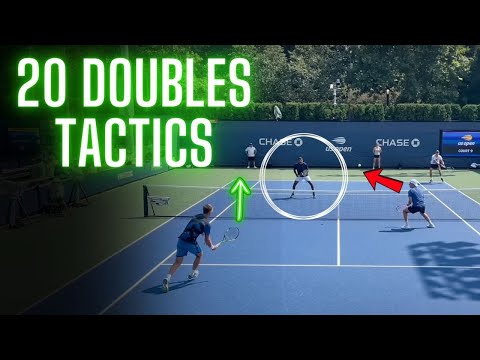
I-Formation Positioning
In I-formation, players should shade toward the side they are serving to. Straddling the center line often over-covers the crosscourt return and leaves the middle more exposed than players realize.
Video Spotlight
In this video, Jonathan Stokke breaks down 18 clips of world-class doubles from the 2024 US Open and shows why elite doubles is less about crazy reactions and more about positioning, assignments, and understanding court geometry before the ball is struck.
Video Link
This page uses a simple preview image and direct YouTube link so the video stays easy to access inside the library.
Video library note
This page keeps the video summary inside TennisTacticsIQ, so players can remember the key tactical ideas even before they rewatch the full video.
Key Takeaways
These are the most useful ideas to carry from the video back into your own doubles matches.
I-Formation Positioning
In I-formation, players should shade toward the side they are serving to. Straddling the center line often over-covers the crosscourt return and leaves the middle more exposed than players realize.
Effective Poaching
Successful poaching is often about starting in the right spot rather than making a spectacular last-second move. If the net player begins closer to the true interception lane, the poach becomes shorter, simpler, and more repeatable.
The Fake Move
Small shoulder and foot cues before the return can push the opponent toward a harder target. Even the threat of a poach can create errors if the returner believes the middle is disappearing.
Controlling Both-Back Opponents
When both opponents stay back, targeting the deuce-side player's backhand helps reduce their inside-out options and makes the net player's job easier by narrowing the likely return shape.
Volley Technique
Good volleying in doubles is calmer than many players think. A quieter racket face aimed toward the target is often more effective than taking a bigger, more aggressive swing at net.
Do Not Just Follow the Ball
Net players should not simply chase the ball with their eyes and body. Better doubles players hold balance and cover the most probable next lane rather than drifting blindly toward whatever they just saw.
Best Use
This video is strongest when it becomes a team rule, not just an interesting clip.
Serve + Formation
Use the video to sharpen how you and your partner position in I-formation and where the net player should really begin.
Poach + Fake
Take the idea that movement itself creates pressure and use it to build cleaner poach and fake cues for your team.
Pattern Translation
You do not need pro-level speed to use the same geometry. The lesson is usually the position, the assignment, and the target, not the athleticism.